Need help with booking? Send us a message.
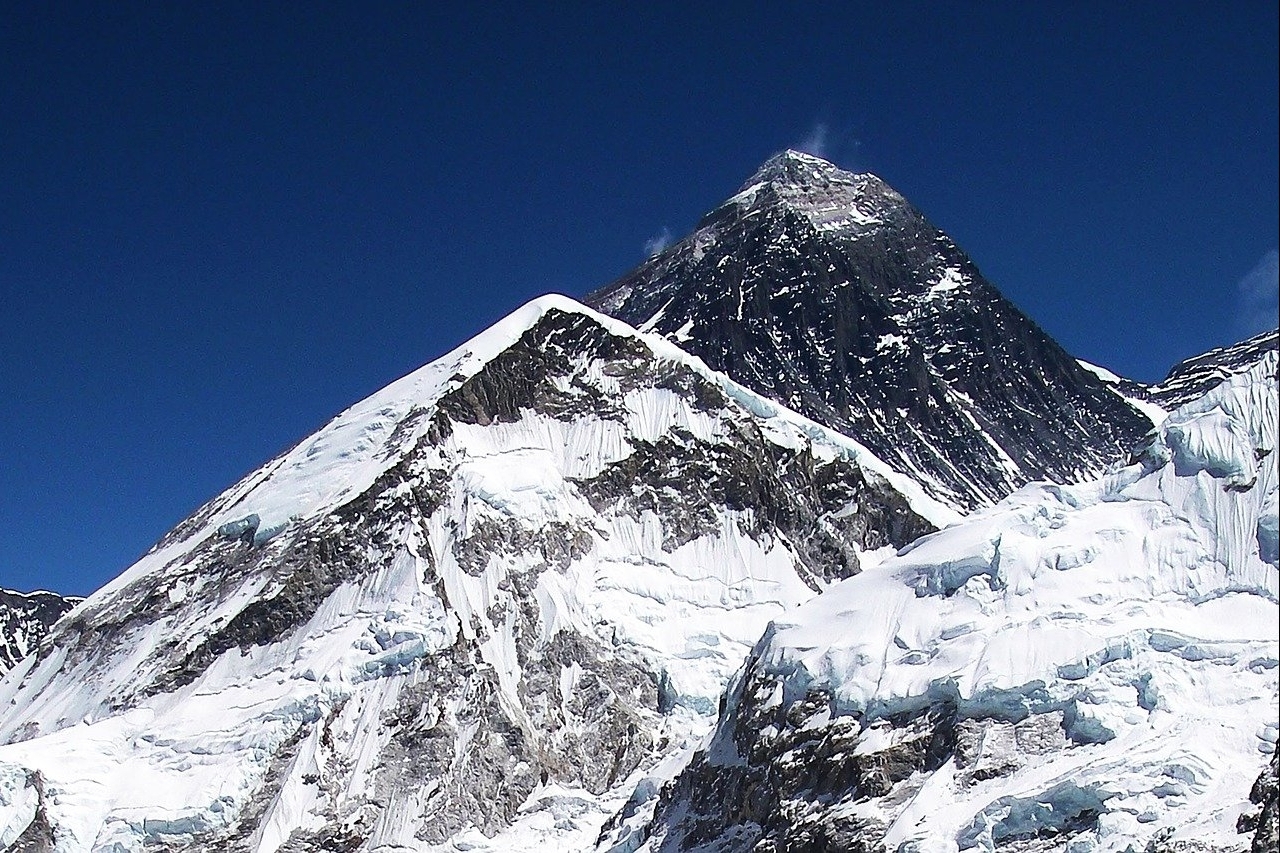
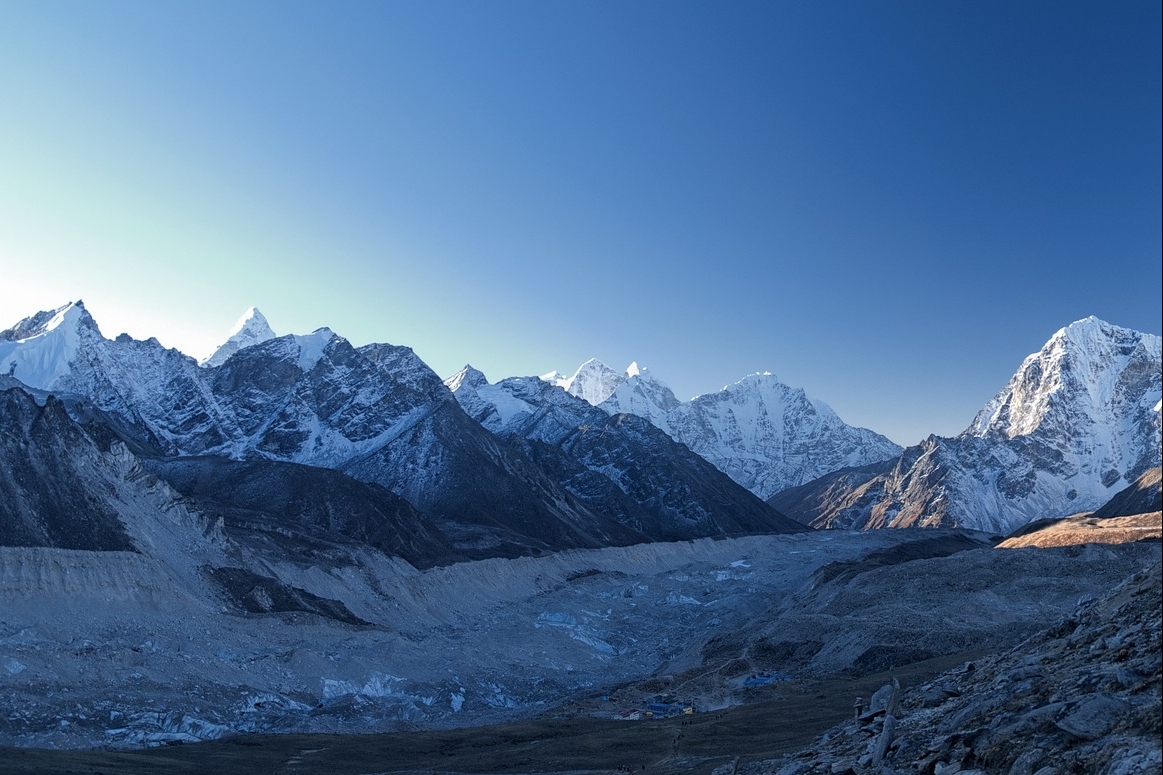
The Everest Three Pass Trek is one of the most exhilarating and challenging trekking adventures in the Khumbu region of Nepal. This trek takes you through the three major high passes of the Everest region: Renjo-La (5,300m), Cho-La (5,420m), and Kongma-La (5,545m). These passes connect the major valleys of the Everest area and offer trekkers breathtaking panoramic views of some of the world’s highest peaks, including Mount Everest, Lhotse, Makalu, Cho Oyu, and the iconic Ama Dablam. The journey is not only about the peaks but also the unique Himalayan landscapes, glaciers, alpine meadows, and traditional Sherpa villages. The opportunity to climb Gokyo Ri and Kala Pattar adds to the adventure, offering one of the best vantage points to witness the grandeur of the Himalayas.
This trek is ideal for those seeking a strenuous and rewarding experience beyond the classic Everest Base Camp route. Although it demands physical endurance and a high level of fitness, the trek does not require technical climbing skills. Along the way, trekkers immerse themselves in Sherpa culture and hospitality, witnessing ancient Buddhist monasteries and experiencing the warm traditions of the mountain people. With Plan Nepal Trek & Expedition, you are assured expert guidance, meticulous planning, and support to make this demanding trek a life-changing experience.
Best Time for Everest Three Pass Trek
The best time to undertake the Everest Three Pass Trek is during the pre-monsoon (spring) and post-monsoon (autumn) seasons. From late March to May, spring brings pleasant temperatures, blooming rhododendrons, and clear skies, making it a favorite time for trekkers. The weather is generally stable, and the mountain views are spectacular. Similarly, the autumn season, from late September to early December, offers crisp, cool air and clear visibility, allowing trekkers to enjoy stunning panoramic views of the Himalayan peaks.
Winter (December to February) can be extremely cold, especially when crossing high passes, and heavy snowfall can pose risks, while the monsoon season (June to early September) brings heavy rain, cloud cover, and slippery trails, making trekking difficult and less enjoyable. Therefore, the spring and autumn seasons are highly recommended to ensure safety, comfort, and the best visual experience during this trek.
Everest Three Pass Trekking Difficulty
The Everest Three Pass Trek is classified as a strenuous and challenging trek due to its high altitude, rugged terrain, and long trekking days. The three passes – Renjo-La, Cho-La, and Kongma-La – all rise above 5,000 meters, requiring trekkers to acclimatize properly to avoid altitude sickness. The trail involves steep ascents and descents, glacier crossings, and sometimes icy patches, demanding good physical fitness, stamina, and mental toughness.
While no technical climbing skills are necessary, trekkers must be comfortable walking on uneven and sometimes slippery terrain. Daily trekking hours range from 4 to 9 hours depending on the section. The trek is suitable for experienced trekkers or those who have prior high-altitude trekking experience, but with proper preparation and guidance from Plan Nepal Trek & Expedition, even moderately fit adventurers can safely complete the journey.
Food and Accommodation for Everest Three Pass Trek
Food along the Everest Three Pass Trek mainly consists of traditional Nepali dishes such as dal bhat (rice and lentils), momos (dumplings), noodles, soups, and various vegetarian and non-vegetarian options available at teahouses and lodges. The meals are hearty and designed to provide the necessary energy for long trekking days. Tea and hot drinks are readily available to help keep warm in the cold mountain environment.
Accommodation on this trek is typically in basic tea houses or lodges located in villages along the route. These lodges provide simple rooms with beds, blankets, and shared or private toilets, though facilities become more basic as you ascend higher. Plan Nepal Trek & Expedition ensures that trekkers stay in clean, safe, and comfortable lodges, and offers support to meet any special dietary needs or preferences throughout the journey.
Why Choose Everest Three Pass Trek with Plan Nepal Trek & Expedition?
Choosing Plan Nepal Trek & Expedition for your Everest Three Pass Trek ensures a professionally organized adventure led by experienced guides who prioritize your safety, comfort, and success. With years of expertise in the Everest region, the company offers personalized itineraries, knowledgeable Sherpa guides, and well-trained support staff who are familiar with the terrain and weather conditions.
Plan Nepal Trek & Expedition also emphasizes responsible tourism, supporting local communities and preserving the fragile environment. Their commitment to quality service, including comprehensive trekking permits, secure transportation, and quality equipment, makes the journey smooth and stress-free. Whether you are a seasoned trekker or attempting the trek for the first time, Plan Nepal Trek & Expedition stands out as a trusted partner for making your Everest Three Pass Trek an unforgettable and rewarding Himalayan experience.
TIPS FOR SAVING ENERGY WHILE TRAVELING.
It's very essential to be in touch with friends' families and colleagues during the trip to provide frequent updates on travel. To do so, the supply of energy to charge the devices to do the web access is very much required, which is very much necessary to save energy.
Following are some tips to save energy:
 Accommodation 3 star hotel
  Meals Welcome Dinner
  Max. altitude 1,400m / 4,593ft. Accommodation Lodge Meals Breakfast, Lunch, and Dinner Max. altitude 2,886m / 9,469ft. Accommodation hotel Meals Lunch and Dinner Max. altitude 3,440m / 11,286ft. Accommodation Hotel Meals Lunch and Dinner Max. altitude 3,440m / 11,286ft. Accommodation Lodge Meals Lunch and Dinner Max. altitude 3,900m / 12,795ft. Accommodation Lodge Meals Lunch and Dinner Max. altitude 4,380m / 14,370ft. Accommodation Lodge Meals Lunch and Dinner Max. altitude 5,388m / 17,677ft. Accommodation Lodge Meals Lunch and Dinner Max. altitude 5,483m / 17,989ft. Accommodation Lodge Meals Lunch and Dinner Max. altitude 4,750m / 15,584ft. Accommodation Lodge Meals Lunch and Dinner Max. altitude 5,420m / 17,782ft. Accommodation Lodge Meals Lunch and Dinner Max. altitude 4,928m / 16,168ft. Accommodation Lodge Meals Lunch and Dinner Max. altitude 5,360m / 17,585ft. Accommodation Tea House Meals Lunch and Dinner Max. altitude 5,554m / 18,222ft. Accommodation Tea House Meals Lunch and Dinner Max. altitude 5,535m / 18,159ft. Accommodation Tea House Meals Lunch and Dinner Max. altitude 5,550m / 18,209ft. Accommodation Tea House Meals Lunch and Dinner Max. altitude 3,664m / 12,021ft. Accommodation Tea House Meals Lunch and Dinner Max. altitude 2,800m / 9,186ft. Accommodation Hotel Meals Breakfast Max. altitude 1,400m / 4,593ft. Accommodation Hotel Meals Breakfast Max. altitude 1,400m / 4,593ft. Accommodation Hotel Meals Breakfast Max. altitude 1,400m / 4,593ft.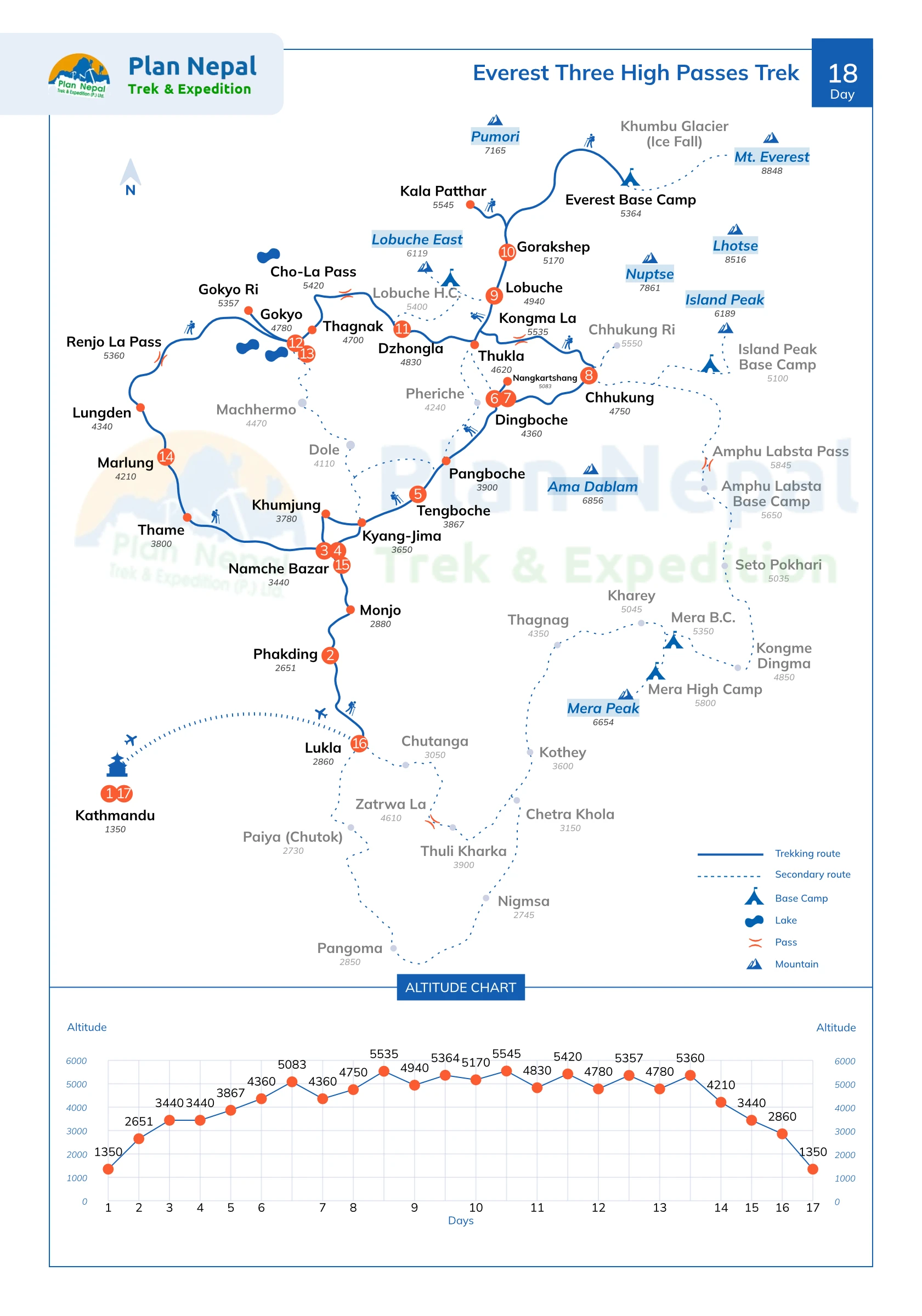
Your Start Date is the day you land in Nepal, and your End Date is when you fly home.
If the set Everest Three Pass Trek group dates don’t suit your schedule, we can offer alternative dates upon request.
Proper layering is important to stay warm and comfortable in changing mountain weather.
Good footwear makes trekking easier and safer.
The right gear keeps you safe, comfortable, and prepared.
Lightweight but important items keep you clean, healthy, and comfortable.
Keep important items safe and easy to reach.
As an adventure-lover from Lowland, the trip around the vicinity of the highest places was thrilling, alongside the thrill of the adventure of the hospitality of the people not just around the region but as of whole nation was beautiful and welcoming like nowhere else. The trip was delightful. Thanks to Mr.Panta and his team for the coordination to make this wonderful trip possible. Looking forward to visiting again
My friends and I had a tremendously beautiful moment in one of the most beautiful nations in the world with amazing natural and cultural vistas. Thanks to the Plan Nepal team for making this trip as beautiful and memorable as possible.
"I am delighted to share that my friends and I had an amazing experience in Nepal, one of the most beautiful countries in the world. I would like to express my sincere gratitude to the Plan Nepal team for their outstanding efforts in making this trip unforgettable."
I recently completed the Everest Three Pass Trek and it was an incredible experience. The trek itself was challenging but extremely rewarding, with breathtaking views of the Himalayas at every turn. The highlight of the trek for me was crossing the three high passes, which provided an immense feeling of accomplishment and stunning panoramic views. It's also correct to say the trip was very penny worth and gave value for money
The trekking company I went with provided excellent support throughout the journey, including experienced guides who were knowledgeable about the trail and the local culture. The meals were delicious and the accommodations were comfortable, making the entire experience all the more enjoyable.
I highly recommend the Everest Three Pass Trek to anyone looking for a challenging and unforgettable adventure in the Himalayas. Just be sure to bring plenty of warm clothing and be prepared for some steep climbs!
The trip is not just adventurous but also full of vibrancy due to the culture and artworks one gets to see in there. The hospitality is one of a kind, people are humble and generous
The Everest Three Pass Trek is considered one of the most demanding trekking routes in the Himalayas. Its difficulty stems from the combination of high-altitude trekking, rugged terrain, and unpredictable weather conditions. Trekkers must cross three major passes — Kongma La (5,550m), Cho La (5,420m), and Renjo La (5,360m) — each involving steep ascents and descents, often on icy or rocky paths. As you climb above 5,000 meters, the air becomes thinner, making breathing more difficult and increasing the risk of altitude sickness. Physical fitness, mental endurance, and proper acclimatization are essential for completing this trek safely and successfully.
The trek is named after the three iconic high mountain passes that it crosses in the Everest region. These are Kongma La Pass (5,550 meters), which is the highest and most challenging of the three; Cho La Pass (5,420 meters), known for its glacier crossing; and Renjo La Pass (5,360 meters), famous for its panoramic Himalayan views. Each pass presents a unique challenge and offers stunning views of peaks like Everest, Lhotse, Makalu, and Ama Dablam. Successfully crossing all three is a major achievement for high-altitude trekkers.
While previous trekking experience is not strictly required, it is highly recommended for the Everest Three Pass Trek due to its high difficulty level. The trek involves long days of hiking over challenging terrain at high altitudes, including snow and ice crossings. Prior experience at altitudes above 4,000 meters, good physical fitness, and mental endurance will significantly enhance your ability to cope with the demands of this trek. First-time trekkers are encouraged to try easier treks like Everest Base Camp or Annapurna Circuit before attempting the Three Passes.
Yes, altitude sickness is a serious concern on the Everest Three Pass Trek, as you'll be spending a lot of time above 4,000 meters and crossing passes over 5,000 meters. Common symptoms include headache, nausea, loss of appetite, and fatigue. To minimize risk, it’s essential to acclimatize properly, follow a gradual ascent, stay hydrated, and avoid alcohol. Plan Nepal Trek & Expedition builds acclimatization days into the itinerary and our guides are trained to recognize symptoms early and act accordingly, including descending if necessary.
Mobile networks (mainly Ncell and NTC) are available in lower regions such as Lukla, Namche Bazaar, and Tengboche. However, signal strength may vary or be unavailable in higher, remote areas. Many teahouses offer paid Wi-Fi, especially in popular villages like Namche and Gokyo, but connections can be slow and unreliable. It’s recommended to inform family or friends beforehand and carry a local SIM card if staying connected is important.
Yes, charging is possible at most teahouses, especially in lower elevations. However, it usually comes at an extra cost ranging from NPR 200 to 500 per device depending on altitude. Power sources are typically solar-powered in higher villages, which can be limited during cloudy weather. It is advisable to bring a power bank or solar charger to ensure you can keep your devices charged, especially for cameras and mobile phones.
To complete the Everest Three Pass Trek, trekkers are required to obtain a Khumbu Pasang Lhamu Rural Municipality Permit, also known as the Khumbu Trek Card, which costs approximately NPR 2,000 per person. This permit is issued in Lukla or Monjo and is mandatory for all visitors entering the Khumbu region. Additionally, trekkers must obtain a Sagarmatha National Park Entry Permit, which costs NPR 3,000 for foreigners. Both permits are crucial and will be checked at multiple points along the trail. It’s advisable to carry photocopies and digital copies throughout the trek.
The ideal seasons for the Everest Three Pass Trek are pre-monsoon (spring) from March to May and post-monsoon (autumn) from late September to early December. During these months, the skies are generally clear, offering spectacular mountain views and more stable weather conditions for crossing high passes. Winter months can be extremely cold with heavy snowfall making the passes impassable, while the monsoon season (June to August) brings rain and landslides, increasing the risk and difficulty of the trek.
Accommodation during the trek is provided in teahouses or lodges, which are simple yet comfortable guesthouses run by local families. Most teahouses offer twin-sharing rooms with basic beds, warm blankets, and shared toilets. In lower regions, facilities may include hot showers and limited Wi-Fi, while in higher altitudes, amenities become more basic. In Kathmandu, accommodation is arranged in a well-rated 3-star hotel with modern facilities for your comfort before and after the trek.
Teahouses offer a variety of meals suited for trekking at high altitude. Typical menus include traditional Nepali meals like dal bhat (lentils and rice), as well as pasta, noodles, soups, fried rice, momos, pancakes, and even apple pie. In Gokyo, you can enjoy treats like fresh bakery items. While the food is mostly vegetarian for safety and freshness, you can also find some non-veg options in lower altitudes. It's important to eat enough carbs and drink plenty of fluids to maintain energy and help acclimatize.
Packing properly is crucial for a successful trek. Essentials include layered clothing (base layers, insulated jackets, waterproof outer layers), trekking boots, gloves, thermal wear, sunglasses, sunscreen, trekking poles, sleeping bag (rated for -15°C or lower), and a water purification system. Other items include a headlamp, first-aid kit, toiletries, snacks, and a power bank. Plan Nepal Trek & Expedition will provide a full gear checklist during your booking process and can assist in renting or purchasing gear in Kathmandu if needed.
Yes, all trekkers will be accompanied by an experienced, government-licensed English-speaking guide and porter service. Our guides are well-trained in high-altitude safety, first aid, and local culture, making your journey both safe and informative. Porters will carry your main luggage (up to 15 kg per trekker), allowing you to hike with just a light daypack. Plan Nepal Trek & Expedition ensures fair treatment of all staff and follows ethical trekking practices.
Yes, travel insurance is mandatory for the Everest Three Pass Trek. Your insurance must cover emergency medical evacuation by helicopter up to 6,000 meters, as well as medical treatment for altitude sickness, accidents, and delays or cancellations. Trekking in such a remote and high-altitude area carries inherent risks, and proper insurance is essential for your safety and peace of mind. Please provide a copy of your insurance before the trek begins.
| No of people | Price per person |
|---|---|
| 1 - 1 | $1,450 |
| 2 - 5 | $1,199 |
| 6 - 12 | $1,150 |
| 13 - 20 | $1,120 |

| No of people | Price per person |
|---|---|
| 1 - 1 | $1,200 |
| 2 - 5 | $1,099 |
| 6 - 12 | $1,075 |
| 13 - 20 | $1,060 |

| No of people | Price per person |
|---|---|
| 1 - 1 | $2,500 |
| 2 - 5 | $2,299 |
| 6 - 12 | $2,280 |
| 13 - 20 | $2,260 |


 (2)
(2)  100% recommend (0)
 (0)
(0)